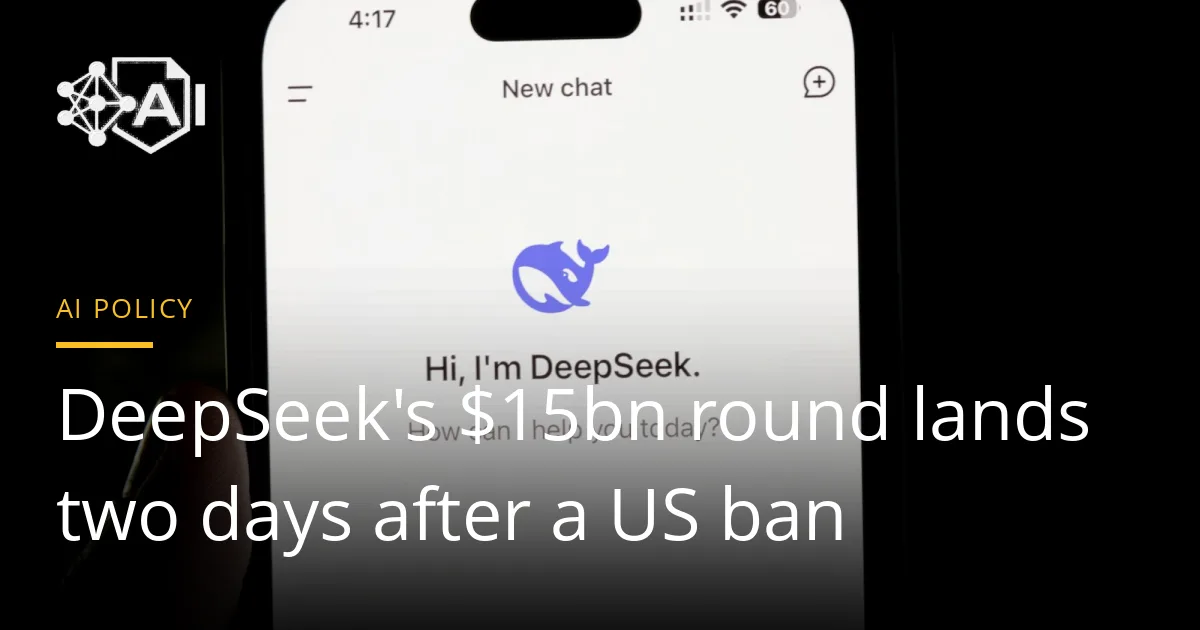
The newest piece of DeepSeek funding news landed on 22 October. Bloomberg reported that the Hangzhou AI lab has raised about $15 billion, roughly 100 billion yuan, in what TechCrunch called one of the largest funding rounds China has seen. The report came two days after the US Department of Homeland Security ordered federal civilian agencies to stop buying DeepSeek products and to remove them from government systems.
The timing makes the two events easy to read as cause and effect. They are better read as a test of what a procurement ban can and cannot do to a company that does most of its business outside the US government.
What the DeepSeek funding report says
TechCrunch's Kate Park summarised the Bloomberg report. The key points:
- The round is about $15 billion, or around 100 billion yuan.
- Potential investors named in the report include battery maker CATL and Tencent, "among others".
- No valuation, terms or closing date were reported.
- DeepSeek did not respond to TechCrunch's request for comment.
The language matters. The size and the investor list are "reported", and the backers are described as "potential". Until DeepSeek or an investor confirms the deal, it should be treated as a well-sourced report rather than a closed transaction.
If it closes at that size, it would be a sharp step up. Reuters reported in June that DeepSeek raised more than $7 billion at a $50 billion valuation. In July, TechCrunch reported the company was seeking about $1.5 billion at a valuation near $71 billion, with a possible listing in China as early as next year. Founder Liang Wenfeng, who co-founded the quantitative hedge fund High-Flyer, keeps an estimated 81.6% of the Chinese operating company, according to WireScreen's analysis of ownership records cited by TechCrunch.
What the US order actually covers
The DHS order was published in the Federal Register on 20 October as a notice of exclusion and removal of DeepSeek products from federal civilian executive branch systems. As reported by TechCrunch, it:
- bars federal civilian agencies from buying DeepSeek products and services;
- requires agencies to remove DeepSeek products already in their IT systems;
- extends to third-party products and services built on DeepSeek technology;
- lets agencies request exceptions.
DHS cited national security concerns and warned that data from US government users could be accessible to Chinese authorities under Chinese law. A separate law passed in December 2025 already restricted DeepSeek in intelligence-related national security systems. We covered the order in more detail when it was issued: DHS orders federal agencies to remove DeepSeek and tools built on it.
China's foreign ministry spokesperson Mao Ning said Beijing opposes "overstretching the concept of national security and politicizing technology and trade issues", and that China would "resolutely safeguard the legitimate rights and interests of Chinese enterprises".
Why a procurement ban does not reach the money
The order controls what the US government buys and runs. It does not stop Chinese investors from funding a Chinese company, and it does not stop businesses outside the federal government, in the US or elsewhere, from downloading DeepSeek's open-weight models.
That gap is by design. Procurement rules are one of the few AI levers an executive agency can pull quickly without new legislation. They protect government data. They are not meant to cut a company off from capital or customers.
Three other tools would reach further, and each has a cost:
- Export controls on chips. These limit the compute a Chinese lab can buy, but they act slowly and push labs towards domestic suppliers.
- Restrictions on outbound investment. These can stop US money flowing into certain Chinese AI firms, but they do nothing about CATL or Tencent.
- Rules on model distribution. Restricting open-weight downloads would hit US and European developers as well, and would be hard to enforce once weights are public.
The distillation question
The order also sits on top of a wider dispute. TechCrunch notes that a September report from the US Cybersecurity and Infrastructure Security Agency accused DeepSeek and five other Chinese AI companies, including Alibaba and Moonshot AI, of large-scale distillation, which means using outputs from US models to train their own. OpenAI told US lawmakers earlier this year it had seen suspected DeepSeek distillation attempts, and Anthropic has said it identified unauthorised attempts by Chinese labs to collect Claude outputs.
If US officials want to act on that, the more likely route is contract and access controls at the US labs themselves, through terms of service, API monitoring and identity checks, rather than another federal ban.
What this means for governments outside the US
For African and other governments weighing their own rules, the episode is a useful case study. A government can protect its own data with procurement rules quickly, as DHS did. That choice tells departments what they can install. It does not decide which models businesses and citizens use, and it will not starve a well-funded lab.
Governments that want a consistent position need to say separately what they expect on data residency for public bodies, how they will treat open-weight models in regulated sectors such as banking and health, and who checks third-party tools that quietly run on a restricted model. The DHS order's line about third-party products is the part most likely to cause work for IT teams, because few vendors disclose which model sits underneath their product.
What to watch next
- Confirmation of the round, its valuation and its investors from DeepSeek or the backers.
- Guidance from US agencies on how they will identify third-party tools built on DeepSeek, and how many exception requests are filed.
- Whether other governments copy the DHS approach for their own civil service systems.
- Any new US action on distillation, which would affect Chinese labs more directly than a procurement ban.
The short version: the ban closes the federal government's door. It was never designed to close DeepSeek's.
Photo: Solen Feyissa / Unsplash