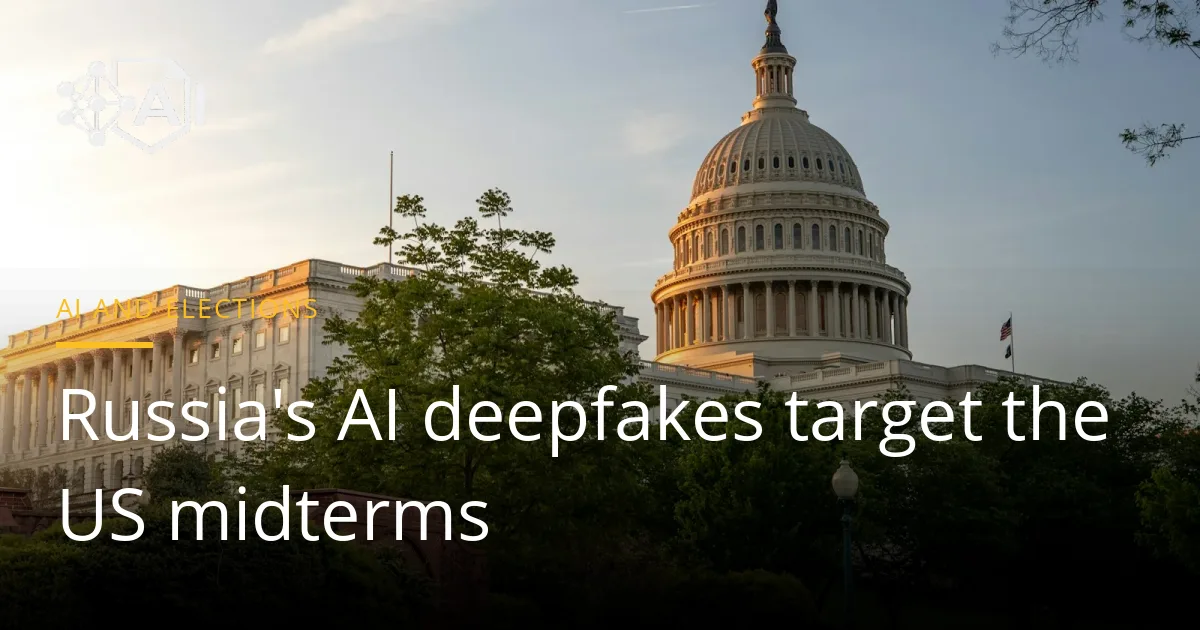
A Russia deepfake campaign is aimed at the 3 November US midterm elections, according to the two most senior Democrats on the congressional intelligence committees. Senator Mark Warner and Representative Jim Himes said on 21 October that a classified election-security briefing they had requested showed Moscow running an online influence operation that leans on AI-generated video, Reuters reported.
The disclosure matters beyond the US. It is one of the clearest cases yet of a government briefing lawmakers on synthetic media being used against named candidates in a live election, and it lands while most countries still have no specific rules for political deepfakes.
What the briefing showed, according to Warner and Himes
The lawmakers said they could reveal little because the material was classified. The briefing came from the office of the Director of National Intelligence, Jay Clayton, at their request.
- Warner said Russia is running the same kind of online misinformation effort that US intelligence tracked in 2016, 2020 and 2024. "Russia, similar to prior occasions, is going after Democrats," he told reporters.
- He pointed to news reports that Texas Senate candidate James Talarico and Georgia Senator Jon Ossoff "in particular are being dinged" by AI-generated fake ads.
- Himes called it "the same old, same old" and said Russia is "throwing everything out there," including messages meant to sow chaos and distrust of voting machines.
- Himes also said there was "no reason to believe" China has stopped what he called "extremely targeted" efforts to influence US voters.
Both men stressed a limit. Himes said there is no evidence that any country can get into US election systems and change results. "Nothing out there suggests that there is even the capability or the intent to do interference," he said. Meduza, summarising a Politico report on the same briefing, wrote that intelligence agencies had found no proven Russian attempt to hack election systems or campaign networks.
The White House, the ODNI and the Russian and Chinese embassies did not immediately respond to Reuters. Moscow and Beijing have denied interfering in past US elections.
The deepfake videos researchers have tracked
The briefing gave official weight to something researchers had been documenting since early September.
Fake celebrities telling people how to vote
Bloomberg reported on 16 October that AI-fabricated clips of actors and musicians, including Robert De Niro, Julia Roberts and Cher, began appearing on X in early September attacking Democrats. Some promoted a hashtag campaign, #AllDemocratsAreCriminals. Researchers linked the posts to Matryoshka, a Russian state-backed operation also known as Operation Overload.
Bots inflating the numbers
The view counts are not what they seem. According to Bloomberg's reporting, as summarised by Meduza, the clips can reach up to 200,000 views in their first hour, after which the counts stop moving. The posts draw almost no likes or reposts, which points to fake engagement rather than real reach.
Attacks on named candidates
NBC News reported that on 20 October videos on X made a baseless sexual assault accusation against Talarico; one post passed 1.3 million views. Researchers at Graphika, Alethea and Clemson University tied that material to Storm-1516, a group they link to Russian military intelligence and which has been accused of election interference in Germany, France and Hungary as well as the US.
Why this is a policy problem, not only a security one
The pattern described here is cheap, fast and hard to answer. A synthetic clip costs little to make, a bot network can push it to the top of a feed, and a correction rarely travels as far as the original. Three gaps stand out.
- No federal deepfake election law. The US has no national rule requiring labels on AI-generated political content. Protection depends on a patchwork of state laws and on each platform's own policy.
- Platform enforcement is opaque. None of the reports above include a statement from X on how many of the clips it removed or labelled, or how quickly.
- Attribution arrives late. The briefing came about two weeks before polling day, roughly six weeks after the first clips surfaced.
Other governments are trying different routes. Denmark has tabled a bill giving people copyright-style control over their own face and voice, which would make unauthorised deepfakes easier to take down; we covered it in Denmark's deepfake bill. The EU's AI Act requires deepfakes to be disclosed as artificially generated, though enforcement of that duty is still being set up.
What to watch before 3 November
- Whether the ODNI publishes an unclassified summary of the threat, as it has done in previous cycles.
- Whether X and other platforms report takedown numbers for Matryoshka and Storm-1516 content.
- Whether campaigns named in the clips seek legal remedies under state deepfake statutes.
- Any sign that the same networks turn on Republican candidates who back Ukraine, a risk lawmakers raised according to Politico's account.
For voters, the practical advice has not changed: be wary of a video of a celebrity or candidate saying something surprising, check whether a named news outlet actually ran it, and treat high view counts with little engagement as a warning sign.
Sources: Reuters (via ThePrint), Meduza summarising Politico, Bloomberg, NBC News.